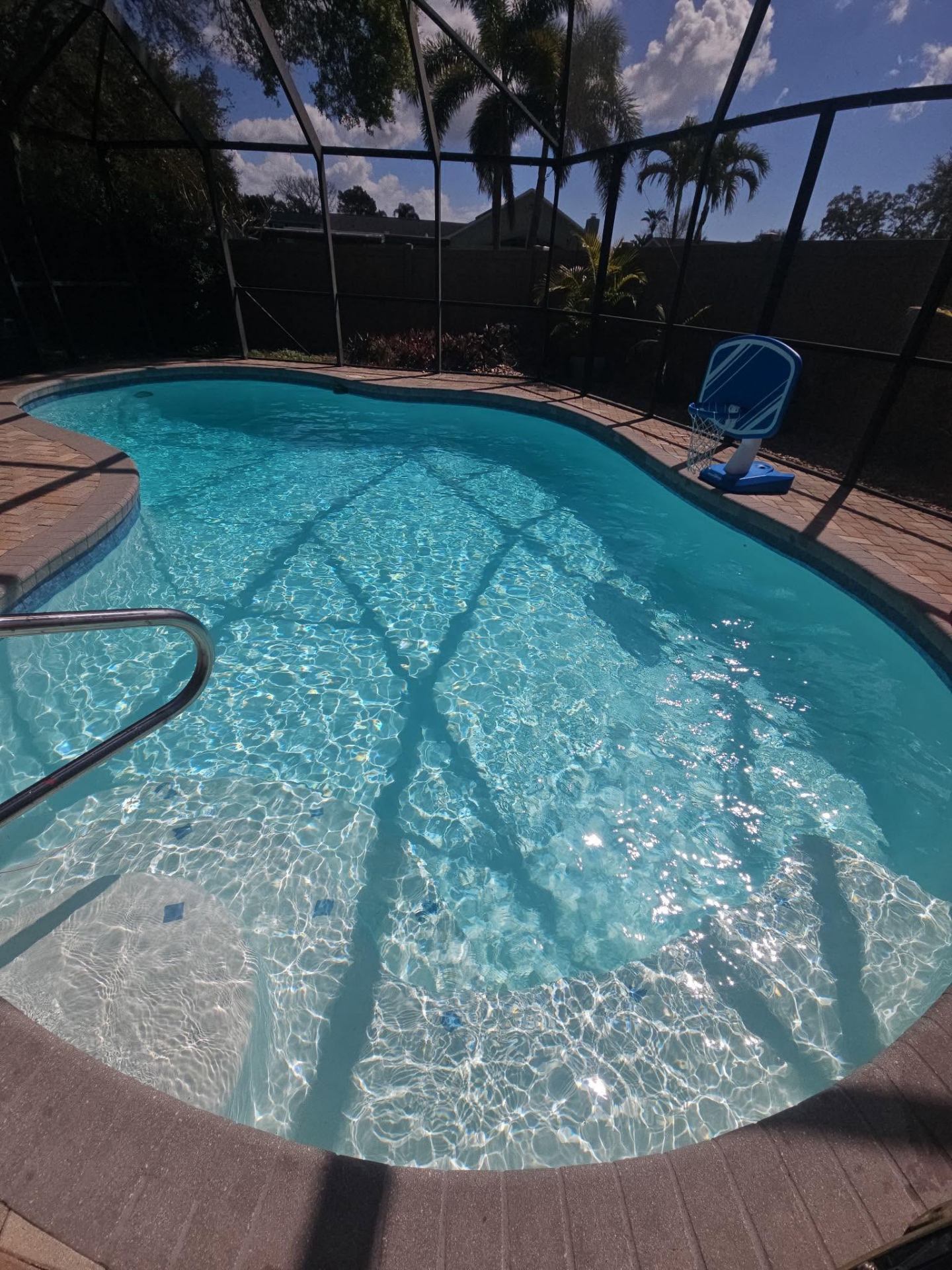
If your Pinellas County pool sits under a screen enclosure, you already know the upside: fewer leaves, fewer frogs, and shade from the worst of the afternoon sun. There are trade-offs worth planning around.
Less sun means lower chlorine demand
Partial shade slows UV burn-off, so caged pools often hold sanitizer better than open pools. That is genuinely helpful in July, but it also means less natural warming, so heater use runs higher in January and February.
The debris changes, it does not disappear
- Fine pollen passes straight through screen mesh and hazes the water
- Dust and sand collect on the screen and wash in with rain
- Insects and lizards get in and end up in the skimmer
- Algae and mildew grow on the screen panels themselves
Airflow and humidity
Enclosures trap Gulf-coast humidity. That accelerates corrosion on fasteners, screws, and any exposed metal near the pool, and it can shorten equipment life if the pad sits inside with poor ventilation. Rinsing the cage frame a few times a year helps significantly.
Maintenance we recommend for cage pools
- Trim trees back from the cage so branches do not tear the mesh in storms
- Rinse screens and the frame periodically to slow mildew and corrosion
- Check and replace deteriorated fasteners before storm season
- Keep brushing on schedule, shaded walls still grow algae
Our technicians service caged and open pools across Clearwater, Largo, Dunedin, Palm Harbor, Seminole, and the rest of Pinellas County. Call (727) 222-0467 to get on the route.
Eddie Hardwick owns and runs Clear Waters Pool Care, servicing residential and commercial pools across Pinellas County, Florida. He has spent years balancing Gulf-coast pool water through summer storms, pollen season, and snowbird turnovers.